Read Wish You Were Eyre Online Free Pdf
| Charlotte Brontë | |
|---|---|
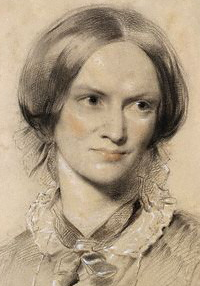 Portrait by George Richmond | |
| Born | (1816-04-21)21 April 1816 Thornton, Yorkshire, England |
| Died | 31 March 1855(1855-03-31) (aged 38) Haworth, Yorkshire, England |
| Resting place | St Michael and All Angels' Church building Haworth, England |
| Pen name |
|
| Occupation | Novelist, poet, governess |
| Nationality | British |
| Genre | Fiction, poesy |
| Notable works |
|
| Spouse | Arthur Bell Nicholls (1000. 1854) |
| Parents |
|
| Relatives | Brontë family unit |
| Signature |  |
Charlotte Brontë (, unremarkably ;[1] 21 April 1816 – 31 March 1855) was an English novelist and poet, the eldest of the three Brontë sisters who survived into machismo and whose novels became classics of English language literature.
She enlisted in school at Roe Head in January 1831, aged xiv years. She left the year after to teach her sisters, Emily and Anne, at home, returning in 1835 as a governess. In 1839, she undertook the role of governess for the Sidgwick family, just left after a few months to return to Haworth, where the sisters opened a schoolhouse, just failed to attract pupils. Instead, they turned to writing and they each kickoff published in 1846 under the pseudonyms of Currer, Ellis, and Acton Bell. Although her first novel, The Professor, was rejected by publishers, her 2d novel, Jane Eyre, was published in 1847. The sisters admitted to their Bell pseudonyms in 1848, and past the following year were celebrated in London literary circles.
Charlotte Brontë was the last to die of all her siblings. She became pregnant shortly later on her wedlock in June 1854 merely died on 31 March 1855, almost certainly from hyperemesis gravidarum, a complication of pregnancy which causes excessive nausea and vomiting.[a]
Early years and education [edit]
Charlotte Brontë was born on 21 April 1816 in Market Street, Thornton, westward of Bradford in the West Riding of Yorkshire, the third of the vi children of Maria (née Branwell) and Patrick Brontë (formerly surnamed Brunty), an Irish Anglican clergyman. In 1820 her family moved a few miles to the village of Haworth, where her begetter had been appointed perpetual curate of St Michael and All Angels Church building. Maria died of cancer on 15 September 1821, leaving five daughters, Maria, Elizabeth, Charlotte, Emily and Anne, and a son, Branwell, to be taken care of by her sister, Elizabeth Branwell.
In August 1824, Patrick sent Charlotte, Emily, Maria, and Elizabeth to the Clergy Daughters' School at Cowan Bridge in Lancashire. Charlotte maintained that the school'due south poor conditions permanently affected her wellness and physical development, and hastened the deaths of Maria (born 1814) and Elizabeth (born 1815), who both died of tuberculosis in June 1825. Afterwards the deaths of his older daughters, Patrick removed Charlotte and Emily from the school.[2] Charlotte used the school as the footing for Lowood School in Jane Eyre.
At domicile in Haworth Parsonage, Brontë acted as "the motherly friend and guardian of her younger sisters".[3] Brontë wrote her showtime known poem at the age of 13 in 1829, and was to go on to write more than 200 poems in the course of her life.[4] Many of her poems were "published" in their bootleg magazine Branwell'due south Blackwood's Mag, and concerned the fictional globe of Glass Town.[4] She and her surviving siblings – Branwell, Emily and Anne – created this shared globe, and began chronicling the lives and struggles of the inhabitants of their imaginary kingdom in 1827.[five] [vi] Charlotte, in individual letters, called Glass Town "her 'earth below', a private escape where she could deed out her desires and multiple identities".[7] Charlotte's "predilection for romantic settings, passionate relationships, and high society is at odds with Branwell'south obsession with battles and politics and her young sisters' homely North Land realism, none the less at this phase there is still a sense of the writings every bit a family enterprise".[8]
However, from 1831 onwards, Emily and Anne 'seceded' from the Glass Town Confederacy to create a 'spin-off' called Gondal, which included many of their poems.[ix] [10] Later 1831, Charlotte and Branwell concentrated on an development of the Drinking glass Town Confederacy called Angria.[5] [eleven] Christine Alexander, a Brontë juvenilia historian,[12] wrote "both Charlotte and Branwell ensured the consistency of their imaginary world. When Branwell exuberantly kills off important characters in his manuscripts, Charlotte comes to the rescue and, in event, resurrects them for the side by side stories [...]; and when Branwell becomes bored with his inventions, such every bit the Glass Town mag he edits, Charlotte takes over his initiative and keeps the publication going for several more than years".[13] : 6–7 The sagas the siblings created were episodic and elaborate, and they exist in incomplete manuscripts, some of which have been published equally juvenilia. They provided them with an obsessive interest during childhood and early boyhood, which prepared them for literary vocations in adulthood.[v]

Betwixt 1831 and 1832, Brontë continued her education at Roe Head in Mirfield, where she met her lifelong friends and correspondents Ellen Nussey and Mary Taylor.[two] In 1833 she wrote a novella, The Dark-green Dwarf, using the name Wellesley. Effectually nearly 1833, her stories shifted from tales of the supernatural to more realistic stories.[xiv] She returned to Roe Caput every bit a teacher from 1835 to 1838. Unhappy and lonely as a instructor at Roe Head, Brontë took out her sorrows in poetry, writing a series of melancholic poems.[15] In "We wove a Web in Babyhood" written in Dec 1835, Brontë drew a sharp contrast betwixt her miserable life as a teacher and the vivid imaginary worlds she and her siblings had created.[15] In some other poem "Morning was its freshness still" written at the same fourth dimension, Brontë wrote "Tis bitter sometimes to recall/Illusions once deemed off-white".[15] Many of her poems concerned the imaginary world of Angria, oftentimes concerning Byronic heroes, and in December 1836 she wrote to the Poet Laureate Robert Southey asking him for encouragement of her career every bit a poet. Southey replied, famously, that "Literature cannot be the business of a adult female's life, and it ought non to be. The more she is engaged in her proper duties, the less leisure will she have for it even every bit an accomplishment and a recreation." This advice she respected simply did not mind.
In 1839, she took upwardly the first of many positions every bit governess to families in Yorkshire, a career she pursued until 1841. In particular, from May to July 1839 she was employed by the Sidgwick family at their summer residence, Rock Gappe, in Lothersdale, where one of her charges was John Benson Sidgwick (1835–1927), an unruly kid who on ane occasion threw the Bible at Charlotte, an incident that may have been the inspiration for a role of the opening affiliate of Jane Eyre in which John Reed throws a book at the young Jane.[16] Brontë did non savour her work every bit a governess, noting her employers treated her almost as a slave, constantly humiliating her.[17]
Brontë was of slight build and was less than five feet alpine.[18]
Brussels and Haworth [edit]

In 1842 Charlotte and Emily travelled to Brussels to enrol at the boarding school run by Constantin Héger (1809–1896) and his married woman Claire Zoé Parent Héger (1804–1887). During her fourth dimension in Brussels, Brontë, who favoured the Protestant ideal of an private in direct contact with God, objected to the stern Catholicism of Madame Héger, which she considered a tyrannical religion that enforced conformity and submission to the Pope.[19] In return for board and tuition Charlotte taught English and Emily taught music. Their fourth dimension at the school was cut brusk when their aunt Elizabeth Branwell, who had joined the family in Haworth to look after the children after their mother's death, died of internal obstacle in October 1842. Charlotte returned alone to Brussels in January 1843 to have up a teaching post at the school. Her second stay was not happy: she was homesick and deeply attached to Constantin Héger. She returned to Haworth in January 1844 and used the time spent in Brussels as the inspiration for some of the events in The Professor and Villette.
Afterwards returning to Haworth, Charlotte and her sisters made headway with opening their own boarding school in the family home. It was advertised every bit "The Misses Brontë'southward Establishment for the Lath and Instruction of a express number of Young Ladies" and inquiries were fabricated to prospective pupils and sources of funding. But none were attracted and in October 1844, the project was abandoned.[twenty]
First publication [edit]
In May 1846 Charlotte, Emily, and Anne self-financed the publication of a joint collection of poems nether their assumed names Currer, Ellis and Acton Bell. The pseudonyms veiled the sisters' sex while preserving their initials; thus Charlotte was Currer Bong. "Bell" was the middle name of Haworth's curate, Arthur Bell Nicholls whom Charlotte later married, and "Currer" was the surname of Frances Mary Richardson Currer who had funded their school (and maybe their male parent).[21] Of the decision to apply noms de plume, Charlotte wrote:
Averse to personal publicity, we veiled our own names under those of Currer, Ellis and Acton Bell; the ambiguous pick being dictated by a sort of conscientious scruple at assuming Christian names positively masculine, while we did not like to declare ourselves women, because – without at that time suspecting that our way of writing and thinking was not what is called "feminine" – we had a vague impression that authoresses are liable to be looked on with prejudice; nosotros had noticed how critics sometimes use for their chastisement the weapon of personality, and for their advantage, a flattery, which is not true praise.[22]
Although only 2 copies of the collection of poems were sold, the sisters continued writing for publication and began their first novels, continuing to use their noms de plume when sending manuscripts to potential publishers.
The Professor and Jane Eyre [edit]
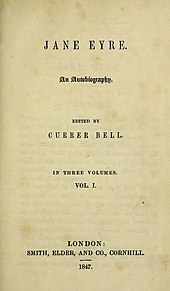
Brontë'southward first manuscript, 'The Professor', did not secure a publisher, although she was heartened by an encouraging response from Smith, Elder & Co. of Cornhill, who expressed an interest in any longer works Currer Bell might wish to send.[23] Brontë responded past finishing and sending a 2d manuscript in August 1847. Six weeks after, Jane Eyre was published. Information technology tells the story of a plain governess, Jane, who, later difficulties in her early life, falls in dear with her employer, Mr Rochester. They marry, but only later on Rochester's insane first married woman, of whom Jane initially has no noesis, dies in a dramatic house fire. The volume's manner was innovative, combining Romanticism, naturalism with gothic melodrama, and broke new footing in beingness written from an intensely evoked first-person female person perspective.[24] Brontë believed art was most convincing when based on personal experience; in Jane Eyre she transformed the feel into a novel with universal entreatment.[25]
Jane Eyre had immediate commercial success and initially received favourable reviews. G. H. Lewes wrote that it was "an utterance from the depths of a struggling, suffering, much-indelible spirit", and alleged that it consisted of "suspiria de profundis!" (sighs from the depths).[25] Speculation nearly the identity and gender of the mysterious Currer Bell heightened with the publication of Wuthering Heights by Ellis Bell (Emily) and Agnes Greyness by Acton Bell (Anne).[26] Accompanying the speculation was a modify in the critical reaction to Brontë's piece of work, as accusations were made that the writing was "coarse",[27] a sentence more readily made once information technology was suspected that Currer Bell was a woman.[28] However, sales of Jane Eyre continued to be strong and may even have increased equally a effect of the novel developing a reputation as an "improper" book.[29] A talented amateur artist, Brontë personally did the drawings for the second edition of Jane Eyre and in the summer of 1834 ii of her paintings were shown at an exhibition past the Majestic Northern Gild for the Encouragement of the Fine Arts in Leeds.[19]
Shirley and bereavements [edit]
In 1848 Brontë began work on the manuscript of her 2d novel, Shirley. It was only partially completed when the Brontë family suffered the deaths of three of its members inside eight months. In September 1848 Branwell died of chronic bronchitis and marasmus, exacerbated by heavy drinking, although Brontë believed that his death was due to tuberculosis. Branwell may take had a laudanum addiction. Emily became seriously ill shortly later his funeral and died of pulmonary tuberculosis in Dec 1848. Anne died of the aforementioned disease in May 1849. Brontë was unable to write at this time.
After Anne's death Brontë resumed writing equally a way of dealing with her grief,[30] and Shirley, which deals with themes of industrial unrest and the role of women in society, was published in October 1849. Different Jane Eyre, which is written in the first person, Shirley is written in the third person and lacks the emotional immediacy of her outset novel,[31] and reviewers found it less shocking. Brontë, as her late sister's heir, suppressed the republication of Anne'southward 2nd novel, The Tenant of Wildfell Hall, an action which had a deleterious event on Anne'due south popularity as a novelist and has remained controversial amongst the sisters' biographers always since.[32]
In society [edit]
In view of the success of her novels, particularly Jane Eyre, Brontë was persuaded by her publisher to make occasional visits to London, where she revealed her truthful identity and began to movement in more exalted social circles, becoming friends with Harriet Martineau and Elizabeth Gaskell, and acquainted with William Makepeace Thackeray and G.H. Lewes. She never left Haworth for more than a few weeks at a time, equally she did not desire to exit her ageing father. Thackeray'south daughter, writer Anne Isabella Thackeray Ritchie, recalled a visit to her father by Brontë:
…two gentlemen come in, leading a tiny, delicate, serious, little lady, with fair direct hair and steady eyes. She may exist a little over thirty; she is dressed in a little barège clothes with a pattern of faint green moss. She enters in mittens, in silence, in seriousness; our hearts are chirapsia with wild excitement. This then is the authoress, the unknown power whose books have set all London talking, reading, speculating; some people even say our father wrote the books – the wonderful books. …The moment is so breathless that dinner comes as a relief to the solemnity of the occasion, and nosotros all smile as my begetter stoops to offering his arm; for, genius though she may be, Miss Brontë can barely reach his elbow. My own personal impressions are that she is somewhat grave and stern, particularly to forward little girls who wish to chatter. …Everyone waited for the brilliant chat which never began at all. Miss Brontë retired to the sofa in the report, and murmured a low discussion now then to our kind governess… the conversation grew dimmer and more dim, the ladies sat round yet expectant, my father was too much perturbed by the gloom and the silence to be able to cope with it at all… subsequently Miss Brontë had left, I was surprised to see my father opening the front door with his hat on. He put his fingers to his lips, walked out into the darkness, and shut the door quietly behind him… long later on… Mrs Procter asked me if I knew what had happened. …It was i of the dullest evenings [Mrs Procter] had e'er spent in her life… the ladies who had all come expecting then much delightful conversation, and the gloom and the constraint, and how finally, overwhelmed by the state of affairs, my begetter had quietly left the room, left the house, and gone off to his guild.[33]
Brontë's friendship with Elizabeth Gaskell, while non peculiarly close, was pregnant in that Gaskell wrote the first biography of Brontë later on her death in 1855.
Villette [edit]
Brontë's third novel, the final published in her lifetime, was Villette, which appeared in 1853. Its master themes include isolation, how such a condition can be borne,[34] and the internal conflict brought almost by social repression of individual desire.[35] Its main character, Lucy Snowe, travels abroad to teach in a boarding school in the fictional town of Villette, where she encounters a culture and organized religion different from her own and falls in dear with a man (Paul Emanuel) whom she cannot ally. Her experiences result in a breakdown but eventually, she achieves independence and fulfilment through running her own school. A substantial amount of the novel's dialogue is in the French language. Villette marked Brontë'due south return to writing from a showtime-person perspective (that of Lucy Snowe), the technique she had used in Jane Eyre. Another similarity to Jane Eyre lies in the use of aspects of her own life every bit inspiration for fictional events,[35] in particular her reworking of the time she spent at the pensionnat in Brussels. Villette was acknowledged past critics of the day every bit a potent and sophisticated piece of writing although it was criticised for "coarseness" and for not being suitably "feminine" in its portrayal of Lucy's desires.[36]
Marriage [edit]

This photo-portrait of Ellen Nussey has long been mistaken for 1 of her friend Charlotte Brontë. The photo is a copy fabricated circa 1918 by the lensman, Sir Emery Walker, from an original menu de visite photo which was then privately endemic.[37] [38]
Before the publication of Villette, Brontë received an expected proposal of marriage from Irishman Arthur Bell Nicholls, her begetter'southward curate, who had long been in love with her.[39] She initially refused him and her male parent objected to the spousal relationship at to the lowest degree partly because of Nicholls's poor financial status. Elizabeth Gaskell, who believed that wedlock provided "clear and defined duties" that were beneficial for a woman,[forty] encouraged Brontë to consider the positive aspects of such a union and tried to use her contacts to engineer an comeback in Nicholls'due south finances. Co-ordinate to James Pope-Hennessy in The Flight of Youth, it was the generosity of Richard Monckton Milnes that made the union possible. Brontë meanwhile was increasingly attracted to Nicholls and past January 1854 she had accepted his proposal. They gained the approval of her father by April and married in June.[41] Her male parent Patrick had intended to give Charlotte away, only at the last minute decided he could non, and Charlotte had to make her way to the church without him.[42] The married couple took their honeymoon in Banagher, County Offaly, Republic of ireland.[43] Past all accounts, her marriage was a success and Brontë plant herself very happy in a way that was new to her.[39]
Death [edit]
Brontë became pregnant soon after her wedding, but her wellness declined speedily and, according to Gaskell, she was attacked by "sensations of perpetual nausea and ever-recurring faintness".[44] She died, with her unborn child, on 31 March 1855, three weeks before her 39th birthday. Her death document gives the crusade of death as phthisis,[45] i.eastward. consumption (not tuberculosis, which was only one of many diseases included in this now outdated classification), but biographers including Claire Harman and others suggest that she died from dehydration and malnourishment due to airsickness caused by astringent morning sickness or hyperemesis gravidarum.[46] Brontë was buried in the family vault in the Church of St Michael and All Angels at Haworth.
The Professor, the start novel Brontë had written, was published posthumously in 1857. The fragment of a new novel she had been writing in her last years has been twice completed past contempo authors, the more famous version beingness Emma Dark-brown: A Novel from the Unfinished Manuscript by Charlotte Brontë by Clare Boylan in 2003. Almost of her writings about the imaginary state Angria have also been published since her death. In 2018, The New York Times published a belated obituary for her.[47]
Religion [edit]
The daughter of an Irish Anglican clergyman, Brontë was herself an Anglican. In a letter to her publisher, she claims to "love the Church of England. Her Ministers indeed, I do not regard as infallible personages, I have seen too much of them for that – merely to the Establishment, with all her faults – the profane Athanasian Creed excluded – I am sincerely fastened."[48]
In a letter of the alphabet to Ellen Nussey she wrote:
If I could always live with you, and "daily" read the [B]ible with you lot, if your lips and mine could at the aforementioned fourth dimension, drink the same draught from the same pure fountain of Mercy – I hope, I trust, I might one day go better, far amend, than my evil wandering thoughts, my decadent heart, cold to the spirit, and warm to the flesh will now permit me to be.[49]
The Life of Charlotte Brontë [edit]

Portrait by J. H. Thompson at the Brontë Parsonage Museum
Elizabeth Gaskell'south biography The Life of Charlotte Brontë was published in 1857. Information technology was an important step for a leading female person novelist to write a biography of another,[50] and Gaskell's approach was unusual in that, rather than analysing her subject area's achievements, she full-bodied on private details of Brontë'south life, emphasising those aspects that countered the accusations of "coarseness" that had been levelled at her writing.[50] The biography is frank in places, but omits details of Brontë's beloved for Héger, a married homo, as being also much of an affront to contemporary morals and a probable source of distress to Brontë'southward male parent, widower, and friends.[51] Mrs Gaskell also provided doubtful and inaccurate data about Patrick Brontë, claiming that he did not let his children to eat meat. This is refuted by ane of Emily Brontë's diary papers, in which she describes preparing meat and potatoes for dinner at the parsonage.[52] It has been argued that Gaskell'south approach transferred the focus of attention away from the 'difficult' novels, not just Brontë's, just all the sisters', and began a procedure of sanctification of their individual lives.[53]
Héger messages [edit]
On 29 July 1913 The Times of London printed four letters Brontë had written to Constantin Héger afterward leaving Brussels in 1844.[54] Written in French except for ane postscript in English, the letters bankrupt the prevailing prototype of Brontë every bit an angelic martyr to Christian and female duties that had been constructed by many biographers, offset with Gaskell.[54] The letters, which formed part of a larger and somewhat one-sided correspondence in which Héger frequently appears not to have replied, reveal that she had been in love with a married man, although they are complex and have been interpreted in numerous ways, including every bit an example of literary self-dramatisation and an expression of gratitude from a sometime pupil.[54]
In 1980 a commemorative plaque was unveiled at the Heart for Fine Arts, Brussels (BOZAR), on the site of the Madam Heger's school, in award of Charlotte and Emily.[55] In May 2017 the plaque was cleaned.[56]
Publications [edit]


Juvenilia [edit]
- The Young Men's Mag, Number one – 3 (August 1830)[57] [58]
- The Spell[59] : 146
- The Secret
- Lily Hart[59] : 157
- The Foundling [sixty]
- Albion and Marina [59] : 129
- Tales of the Islanders [61]
- Tales of Angria (written 1838–1839 – a collection of childhood and young adult writings including v short novels)
- Mina Laury [59] : 119
- Stancliffe'south Hotel [59] : 166
- The Duke of Zamorna
- Henry Hastings[b] [59] : 15, 100
- Caroline Vernon [59] : 46
- The Roe Head Journal Fragments [59] : 147
- Farewell to Angria[seven]
The Green Dwarf, A Tale of the Perfect Tense was written in 1833 under the pseudonym Lord Charles Albert Florian Wellesley.[62] It shows the influence of Walter Scott, and Brontë's modifications to her earlier gothic mode have led Christine Alexander to annotate that, in the piece of work, "it is clear that Brontë was becoming tired of the gothic manner per se".[63]
"At the terminate of 1839, Brontë said goodbye to her fantasy earth in a manuscript called Farewell to Angria. More and more, she was finding that she preferred to escape to her imagined worlds over remaining in reality – and she feared that she was going mad. So she said goodbye to her characters, scenes and subjects. [...] She wrote of the pain she felt at wrenching herself from her 'friends' and venturing into lands unknown".[7]
Novels [edit]
- Jane Eyre, published in 1847
- Shirley, published in 1849
- Villette, published in 1853
- The Professor, written before Jane Eyre, was first submitted together with Wuthering Heights by Emily Brontë and Agnes Greyness by Anne Brontë. Later on, The Professor was resubmitted separately, and rejected by many publishing houses. Information technology was published posthumously in 1857
- Emma, unfinished; Brontë wrote only 20 pages of the manuscript, published posthumously in 1860. In recent decades at least two continuations of this fragment accept appeared:
- Emma, by "Charlotte Brontë and Another Lady", published 1980; although this has been attributed to Elizabeth Goudge,[64] the actual author was Constance Savery.[65]
- Emma Chocolate-brown, past Clare Boylan, published 2003
Verse [edit]
- Poems by Currer, Ellis, and Acton Bell (1846)
- Selected Poems of the Brontës, Everyman Verse (1997)
Notes [edit]
- ^ "Hyperemesis", Greek: "overvomiting"; "gravidarum", Latin: "of pregnant females".
- ^ Charlotte wrote this slice, however, Branwell also used the name Henry Hastings equally a pseudonym in their juvenilia.
References [edit]
- ^ As given by Merriam-Webster Encyclopedia of Literature (Merriam-Webster, incorporated, Publishers: Springfield, Massachusetts, 1995), p. viii: "When our research shows that an author's pronunciation of his or her proper name differs from common usage, the writer'southward pronunciation is listed first, and the descriptor commonly precedes the more familiar pronunciation." See also entries on Anne, Charlotte and Emily Brontë, pp. 175–176.
- ^ a b Fraser 2008, p. 261.
- ^ Cousin, John (1910). A Brusk Biographical Lexicon of English Literature. East.P. Dutton & Co.
- ^ a b Paddock & Rollyson 2003, p. 119.
- ^ a b c Miller 2005, p. 5.
- ^ Harrison, David W (2003). The Brontes of Haworth. Trafford Publishing. ISBN978-1-55369-809-eight.
- ^ a b c "The secret history of Jane Eyre: Charlotte Brontë'south private fantasy stories". The Guardian. 21 April 2016. Retrieved 6 June 2021.
- ^ Thomson, Patricia (1989). "Review". The Review of English language Studies. twoscore (158): 284. ISSN 0034-6551. JSTOR 516528 – via JSTOR.
- ^ Maye, Brian. "Understanding Emily Brontë: 'Stronger than a human being, simpler than a kid'". The Irish gaelic Times . Retrieved six June 2021.
- ^ Cost, Sandra Leigh (17 May 2018). "Emily Bronte and Me". The Sydney Morning Herald . Retrieved half-dozen June 2021.
- ^ "Brontë juvenilia: The History of Angria". The British Library . Retrieved vii June 2021.
- ^ Plater, Diana (6 June 2016). "Professor Christine Alexander and Charlotte Bronte's juvenilia". The Sydney Morning Herald . Retrieved 7 June 2021.
- ^ Alexander, Christine (4 July 2018). "In Search of the Authorial Self: Branwell Brontë's Microcosmic World". Periodical of Juvenilia Studies. one: 3–xix. doi:10.29173/jjs126. ISSN 2561-8326.
- ^ Paddock & Rollyson 2003, p. 8.
- ^ a b c Paddock & Rollyson 2003, p. 120.
- ^ Phillips-Evans 2012, pp. 260–261.
- ^ Paddock & Rollyson 2003, p. 18.
- ^ "Charlotte Brontë; Bronte Parsonage Museum". Bronte.org.uk. Retrieved 26 March 2016.
- ^ a b Paddock & Rollyson 2003, p. 29.
- ^ Harman, Claire (2015). Charlotte Bronte: A Fiery Heart. Vintage. pp. 206–viii. ISBN978-0-30796208-nine.
- ^ Lee, Colin (2004). "Currer, Frances Mary Richardson (1785–1861)". Oxford Dictionary of National Biography. Vol. i. Oxford University Printing. doi:10.1093/ref:odnb/6951. Retrieved ane November 2014.
- ^ "Biographical Discover of Ellis And Acton Bong", from the preface to the 1910 edition of Wuthering Heights.
- ^ Miller 2002, p. 14.
- ^ Miller 2002, pp. 12–13.
- ^ a b Miller 2002, p. thirteen.
- ^ Miller 2002, p. xv.
- ^ Fraser 2008, p. 24.
- ^ Miller 2002, p. 17.
- ^ North American Review, October 1848, cited in The Brontës: The Critical Heritage by Allott, M. (ed.), Routledge and Kegan Paul, 1974, cited in Miller (p18)
- ^ Letter from Charlotte to her publisher, 25 June 1849, from Smith, M, ed. (1995). The Letters of Charlotte Brontë: Book Two, 1848 – 1851. Clarendon Press. cited in Miller 2002, p. 19
- ^ Miller 2002, p. xix.
- ^ The Novels of Anne Brontë.
- ^ Anne Isabella Thackeray Ritchie. Capacity from Some Memoirs, cited in Sutherland, James (ed.) The Oxford Book of Literary Anecdotes. OUP, 1975. ISBN 0-19-812139-3.
- ^ Reid Banks, L. (1977). Path to the Silent Land. Penguin. p. 113.
- ^ a b Miller 2002, p. 47.
- ^ Miller 2002, p. 52.
- ^ "To walk invisible". Mail service. TLS. xxx September 2015. Archived from the original on 4 March 2016. Retrieved 26 March 2016.
- ^ "The Bronte Sisters – A True Likeness? – Photo of Charlotte Bronte". brontesisters.co.uk . Retrieved half dozen September 2017.
- ^ a b Paddock & Rollyson 2003, p. nineteen.
- ^ Miller 2002, p. 54.
- ^ Miller 2002, pp. 54–55.
- ^ "Being the Brontes – Charlotte Bronte's marriage with The Rev. Arthur Bong Nicholls". BBC. 26 March 2016. Retrieved 26 March 2016.
- ^ Alexander, Christine; Sellars, Jane (1995). The Art of the Brontës . Cambridge University Press. p. 402. ISBN978-0-521-43248-one.
- ^ "Existent life plot twists of famous authors". CNN. 25 September 2007. Retrieved 12 June 2013.
- ^ "Expiry document". twitter.com . Retrieved 21 December 2021.
- ^ Allison, SP; Lobo, DN (x February 2019). "The death of Charlotte Brontë from hyperemesis gravidarum and refeeding syndrome: A new perspective". Clinical Diet (Edinburgh, Scotland). 39 (1): 304–305. doi:10.1016/j.clnu.2019.01.027. PMID 30777294. S2CID 73468434.
- ^ Dominus, Susan (eight March 2018). "Disregarded No More: Charlotte Brontë, Novelist Known for 'Jane Eyre'". The New York Times. Archived from the original on one January 2022.
- ^ Griesinger, Emily (Autumn 2008). "Charlotte Bronte'southward Religion: Faith, Feminism, and Jane Eyre". Christianity and Literature. 58 (ane): 29–59. doi:10.1177/014833310805800103.
- ^ Griesinger, Emily (Autumn 2008). "Charlotte Bronte's Religion: Faith, Feminism, and Jane Eyre". Christianity and Literature. 58 (1): 29–59. doi:10.1177/014833310805800103.
- ^ a b Miller 2002, p. 57.
- ^ Lane 1953, pp. 178–83.
- ^ Juliet Barker, The Brontës
- ^ Miller 2002, pp. 57–58.
- ^ a b c Miller 2002, p. 109.
- ^ "A Plaque is Unveiled in Brussels to Commemorate the Stay of Charlotte and Emily Brontë at the Pensionnat Heger". Brontë Society Transactions. Taylor & Francis. 17 (5): 371–374. 1980. doi:10.1179/030977680796471592.
- ^ "Brontë Society plaque on Bozar gets a facelift". brusselsbronte.blogspot.co.united kingdom of great britain and northern ireland. 23 May 2017. Retrieved 27 May 2018.
- ^ Barnard, Robert (2007). A Brontë encyclopedia. Louise Barnard. Malden, MA: Blackwell Pub. pp. 29, 34–35. ISBN978-1-4051-5119-i. OCLC 76064670.
- ^ Glen, Heather (2004). Charlotte Brontë : the imagination in history. Oxford: Oxford University Press. p. 9. ISBN978-ane-4294-7076-6. OCLC 139984116.
- ^ a b c d due east f g h Butcher, Emma (2019). The Brontës and War : Fantasy and Disharmonize in Charlotte and Branwell Brontë's Youthful Writings. Cham: Palgrave Macmillan. ISBN978-iii-319-95636-7. OCLC 1130021690.
- ^ "Charlotte Brontë's Unpublished Works Discovered". Newsweek. 13 November 2015. Retrieved 13 June 2021.
- ^ "Tales of the Islanders". Oxford Reference.
Volumes 1–4, written between 31 [sic] June 1829 and 30 June 1830, is Charlotte Brontë's first extended endeavour at storytelling
- ^ Shorter, Clement Rex (19 September 2013). The Brontës Life and Messages: Beingness an Endeavour to Present a Full and Final Tape of the Lives of the Three Sisters, Charlotte, Emily and Anne Brontë. Cambridge University Press. ISBN9781108065238 . Retrieved 2 Feb 2019 – via Google Books.
- ^ Alexander 1993, pp. 430–432.
- ^ "Review of Emma Brown by Charlotte Cory". The Independent. 13 September 2003. Archived from the original on 19 September 2011. Retrieved 12 June 2013.
- ^ Bronte, Charlotta and Another Lady. Emma. Moscow: Folio. 2001. xi.
Sources [edit]
- Alexander, Christine (March 1993). "'That Kingdom of Gloo': Charlotte Brontë, the Annuals and the Gothic". Nineteenth-Century Literature. 47 (four): 409–436. doi:10.2307/2933782. JSTOR 2933782.
- Fraser, Rebecca (2008). Charlotte Brontë: A Writer'due south Life (2 ed.). New York: Pegasus Books LLC. p. 261. ISBN978-one-933648-88-0.
- Lane, Margaret (1953). The Brontë Story: a reconsideration of Mrs. Gaskell'due south Life of Charlotte Brontë .
- Miller, Lucasta (2002). The Brontë Myth. London: Vintage. ISBN978-0-09-928714-8.
- Miller, Lucasta (2005). The Brontë Myth . New York: Ballast. ISBN978-1400078356.
- Paddock, Lisa; Rollyson, Carl (2003). The Brontës A to Z . New York: Facts on File. ISBN978-0-8160-4303-3.
- Phillips-Evans, James (2012). The Longcrofts: 500 Years of a British Family. Amazon. pp. 260–261. ISBN978-1481020886.
- Potter, Dawn (Summertime 2010). "Inventing Charlotte Brontë". The Sewanee Review. 118 (3): 393–399. doi:10.1353/stitch.2010.0014. S2CID 161213323.
-
 This article incorporates text from a publication now in the public domain:Cousin, John William (1910). A Short Biographical Lexicon of English Literature. London: J. M. Dent & Sons – via Wikisource.
Further reading [edit]
- The Messages of Charlotte Brontë, iii volumes edited by Margaret Smith, 2007
- The Life of Charlotte Brontë, Elizabeth Gaskell, 1857
- Charlotte Brontë, Winifred Gérin
- Charlotte Brontë: a passionate life, Lyndal Gordon
- The Literary Protégées of the Lake Poets, Dennis Low (Chapter 1 contains a revisionist contextualisation of Robert Southey's infamous letter to Charlotte Brontë)
- Charlotte Brontë: Unquiet Soul, Margot Peters
- In the Footsteps of the Brontës, Ellis Chadwick
- The Brontës, Juliet Barker
- Charlotte Brontë and her Beloved Nell, Barbara Whitehead
- The Brontë Myth, Lucasta Miller
- A Life in Letters, selected by Juliet Barker
- Charlotte Brontë and Defensive Bear: The Writer and the Body at Risk, Janet Gezari, University of Pennsylvania Press, 1992
- Charlotte Brontë: Truculent Spirit, past Valerie Grosvenor Myer, 1987
- Charlotte Brontë and her Family unit, Rebecca Fraser
- The Oxford Reader's Companion to the Brontës, Christine Alexander & Margaret Smith
- Charlotte & Arthur, Pauline Clooney (2021) ISBN 978-1916501676 . Reimagining Charlotte Brontë'south honeymoon in Ireland & Wales.
- A Brontë Family unit Chronology, Edward Chitham
- The Crimes of Charlotte Brontë, James Tully, 1999
- Daly, Michelle (2013). I Dearest Charlotte Brontë. Michelle Daly. ISBN978-0957048751. A book about Brontë through the optics of a working-grade adult female
- Heslewood, Juliet (2017). Mr Nicholls. Yorkshire: Scratching Shed. ISBN978-0993510168. Fictionalised account of Arthur Bells Nicholls' romance of Charlotte Brontë
- O'Dowd, Michael (2021). Charlotte Brontë, An Irish Odyssey: My Heart is Knit to Him-The Honeymoon. Pardus Media. ISBN978-1914939051. Charlotte Brontë and Arthur Bell Nicholls' wedding trip and Irish Odyssey.
External links [edit]
- Website of the Brontë Society and Parsonage Museum in Haworth, Yorkshire
- Modern Solar day Images of Charlotte Brontë Residences (Archived)
- Charlotte Brontë at the Internet Book Listing
- Charlotte'south Web: A Hypertext on Charlotte Brontë's Jane Eyre (Archived)
- Rare Charlotte Bronte book coming home afterward museum's sale success
- Poems by Charlotte Brontё
Electronic editions [edit]
- Works by Charlotte Brontë in eBook class at Standard Ebooks
- Works by Charlotte Brontë at Projection Gutenberg
- Works past Charlotte Brontë at Faded Page (Canada)
- Works past or about Charlotte Brontë at Internet Archive
- Works past Charlotte Brontë at LibriVox (public domain audiobooks)

thompsonphrebre92.blogspot.com
Source: https://en.wikipedia.org/wiki/Charlotte_Bront%C3%AB
0 Response to "Read Wish You Were Eyre Online Free Pdf"
Postar um comentário