Device That Continuously Measures Blood Pressure

NEED The traditional blood pressure cuff measures blood pressure by external pressure to the point of occlusion of an artery (usually the brachial). It is a technique that is not as accurate as an indwelling arterial line, which must be placed surgically, and thus is not practical for outpatient settings. The blood pressure cuff also relies on a proper cuff size for the patient, appropriate placement on the arm and the cooperation of the patient. Less invasive, error-prone methods such as the cuffless blood pressure monitor are worth investigating.
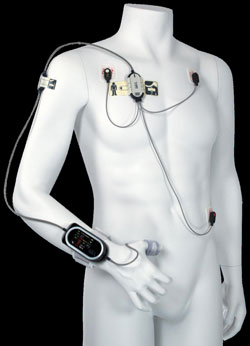
SCALE One major advantage of devices such as the Sotera's ViSi Mobile cuffless monitor is its size - not much larger than a watch, if fits over the wrist and thumb.
IMPACT While there is no shortage of wearable health data devices on the market, the technology to make a cuffless BP monitor available has evaded designers for a long time. This product, one of the first of its kind to receive FDA approval, makes monitoring an important vital sign and continuously possible for both an inpatient, outpatient and home setting. This device could be used to reduce patient anxiety and promote more accurate BP measurements in health care settings, as well as bring continuous monitoring capabilities to the home environment, so that patients who experience "white coat syndrome" in the office can reassure themselves and their doctors that they are well.
TECHNOLOGY

FEASIBILITY/RISKS/COST/BARRIERS Price data for this relatively new technology was difficult to find. Thus far, marketing appears focused on the inpatient/hospital setting. One potential risk involved in continuously monitoring a patient's blood pressure (versus intermittent monitoring) include data "immunity" whereby the provider is overwhelmed with a continuous stream of data from all of their patients, leading to loss of attention and missed diagnosis or medical errors. Reliance on electronic monitors by providers, including nurses, may lead to inexperience with manual methods of measuring health data, leading to unpreparedness in the event of a technical failure or power outage.
SHORTCOMINGS/CRITICISMS Currently, the device requires calibration with a cuffed BP monitor for the initial reading, after which the cuff can be removed. The BP function can't be isolated from the other vitals, which require a network of cables (for example, the EKG leads which must be applied to the chest). For inpatient use, it may be distracting/distressing for patients to have continuous knowledge of the fluctuations in their blood pressure, heart rate, electrocardiogram tracing, etc without the knowledge to interpret those data. If the device were to be used in an ICU setting, it makes the data less visible to the provider at a glance. The data are available on a screen, but not bedside, where providers may be accustomed to viewing them.
SOURCES
David Szondy, "Wearable ViSi Mobile System Lets Doctors Wirelessly Monitor Patients," Gizmag, December 30, 2012, accessed September 21, 2014, http://www.gizmag.com/visi-mobile-wireless-health-monitoring/25583/.
Sang-Suk Lee, Dong-Hyun Nam, You-Sik Hong, Woo-Beom Lee, Il-Ho Son, Keun-Ho Kim, and Jong-Gu Choi, "Measurement of Blood Pressure Using an Arterial Pulsimeter Equipped with a Hall Device," Sensors, 11 (2011): 1784-1793.
VisiMobile, accessed September 29, 2014, http://www.visimobile.com/.
thompsonphrebre92.blogspot.com
Source: http://cargocollective.com/futurehealth/VisiMobile-Continuous-Blood-Pressure-Monitor
0 Response to "Device That Continuously Measures Blood Pressure"
Postar um comentário