Can the Speed of a Rocket Exceed the Exhaust Speed of the Fuel
Learning Objectives
By the finish of this section, you volition be able to:
- Describe the awarding of conservation of momentum when the mass changes with time, likewise equally the velocity
- Summate the speed of a rocket in empty space, at some time, given initial atmospheric condition
- Calculate the speed of a rocket in Earth's gravity field, at some time, given initial weather
Now we bargain with the example where the mass of an object is changing. We analyze the motion of a rocket, which changes its velocity (and hence its momentum) by ejecting burned fuel gases, thus causing it to advance in the opposite direction of the velocity of the ejected fuel (see (Figure)). Specifically: A fully fueled rocket ship in deep infinite has a total mass [latex] {m}_{0} [/latex] (this mass includes the initial mass of the fuel). At some moment in time, the rocket has a velocity [latex] \overset{\to }{five} [/latex] and mass chiliad; this mass is a combination of the mass of the empty rocket and the mass of the remaining unburned fuel it contains. (We refer to m every bit the "instantaneous mass" and [latex] \overset{\to }{v} [/latex] every bit the "instantaneous velocity.") The rocket accelerates by called-for the fuel information technology carries and ejecting the burned exhaust gases. If the burn rate of the fuel is constant, and the velocity at which the exhaust is ejected is besides abiding, what is the alter of velocity of the rocket as a event of burning all of its fuel?
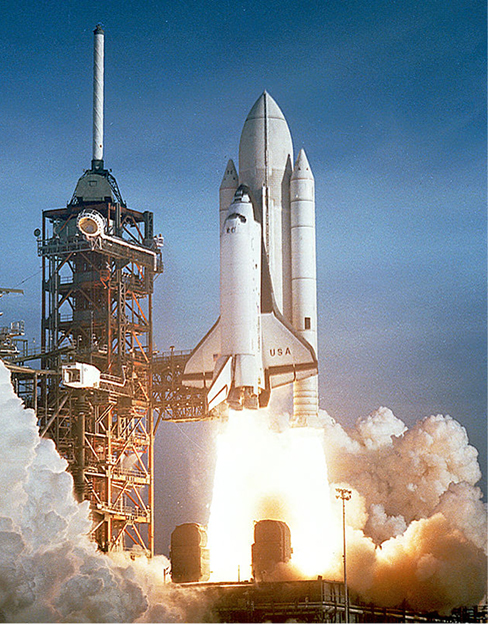
Figure 9.32 The space shuttle had a number of reusable parts. Solid fuel boosters on either side were recovered and refueled subsequently each flight, and the entire orbiter returned to Earth for employ in subsequent flights. The large liquid fuel tank was expended. The space shuttle was a circuitous assemblage of technologies, employing both solid and liquid fuel, and pioneering ceramic tiles as reentry oestrus shields. As a result, it permitted multiple launches equally opposed to unmarried-utilize rockets. (credit: modification of piece of work by NASA)
Physical Analysis
Here's a description of what happens, so that you get a feel for the physics involved.
- Equally the rocket engines operate, they are continuously ejecting burned fuel gases, which accept both mass and velocity, and therefore some momentum. By conservation of momentum, the rocket's momentum changes by this same corporeality (with the opposite sign). We will assume the burned fuel is being ejected at a abiding rate, which means the rate of change of the rocket'southward momentum is also constant. By (Figure), this represents a abiding forcefulness on the rocket.
- However, as time goes on, the mass of the rocket (which includes the mass of the remaining fuel) continuously decreases. Thus, fifty-fifty though the force on the rocket is abiding, the resulting acceleration is not; it is continuously increasing.
- So, the total change of the rocket'southward velocity will depend on the amount of mass of fuel that is burned, and that dependence is not linear.
The problem has the mass and velocity of the rocket changing; as well, the full mass of ejected gases is changing. If nosotros define our arrangement to be the rocket + fuel, so this is a closed system (since the rocket is in deep space, at that place are no external forces acting on this system); as a result, momentum is conserved for this organisation. Thus, we tin can apply conservation of momentum to answer the question ((Figure)).
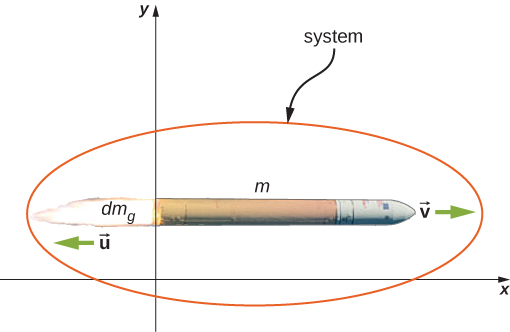
Figure 9.33 The rocket accelerates to the right due to the expulsion of some of its fuel mass to the left. Conservation of momentum enables us to determine the resulting change of velocity. The mass grand is the instantaneous total mass of the rocket (i.e., mass of rocket body plus mass of fuel at that bespeak in fourth dimension). (credit: modification of piece of work past NASA/Bill Ingalls)
At the same moment that the total instantaneous rocket mass is m (i.e., m is the mass of the rocket body plus the mass of the fuel at that signal in time), we define the rocket's instantaneous velocity to be [latex] \overset{\to }{v}=v\hat{i} [/latex] (in the +ten-management); this velocity is measured relative to an inertial reference system (the Earth, for instance). Thus, the initial momentum of the organization is
[latex] {\overset{\to }{p}}_{\text{i}}=mv\chapeau{i}. [/latex]
The rocket'southward engines are burning fuel at a constant charge per unit and ejecting the exhaust gases in the −x-management. During an minute fourth dimension interval dt, the engines eject a (positive) infinitesimal mass of gas [latex] d{m}_{m} [/latex] at velocity [latex] \overset{\to }{u}=\text{−}u\hat{i} [/latex]; note that although the rocket velocity [latex] five\hat{i} [/latex] is measured with respect to Earth, the exhaust gas velocity is measured with respect to the (moving) rocket. Measured with respect to the Earth, therefore, the frazzle gas has velocity [latex] (v-u)\hat{i} [/latex].
As a consequence of the ejection of the fuel gas, the rocket'southward mass decreases by [latex] d{m}_{g} [/latex], and its velocity increases by [latex] dv\hat{i} [/latex]. Therefore, including both the modify for the rocket and the change for the exhaust gas, the terminal momentum of the system is
[latex] \begin{assortment}{cc}\hfill {\overset{\to }{p}}_{\text{f}}& ={\overset{\to }{p}}_{\text{rocket}}+{\overset{\to }{p}}_{\text{gas}}\hfill \\ & =(m-d{m}_{g})(v+dv)\hat{i}+d{m}_{g}(five-u)\hat{i}\hfill \end{assortment}\text{.} [/latex]
Since all vectors are in the x-direction, we driblet the vector note. Applying conservation of momentum, we obtain
[latex] \begin{assortment}{50}{p}_{\text{i}}={p}_{\text{f}}\\ mv=(g-d{m}_{g})(five+dv)+d{m}_{m}(5-u)\\ mv=mv+mdv-d{m}_{k}5-d{k}_{g}dv+d{thousand}_{g}v-d{m}_{one thousand}u\\ mdv=d{m}_{1000}dv+d{m}_{g}v.\end{array} [/latex]
Now, [latex] d{m}_{g} [/latex] and dv are each very small; thus, their production [latex] d{m}_{one thousand}dv [/latex] is very, very pocket-sized, much smaller than the other two terms in this expression. Nosotros fail this term, therefore, and obtain:
[latex] mdv=d{grand}_{g}u. [/latex]
Our adjacent step is to recollect that, since [latex] d{m}_{one thousand} [/latex] represents an increment in the mass of ejected gases, it must too stand for a decrease of mass of the rocket:
[latex] d{g}_{1000}=\text{−}dm. [/latex]
Replacing this, we have
[latex] mdv=\text{−}dmu [/latex]
or
[latex] dv=\text{−}u\frac{dm}{thou}. [/latex]
Integrating from the initial mass m i to the concluding mass m of the rocket gives usa the result we are after:
[latex] \brainstorm{array}{ccc}\hfill {\int }_{{v}_{\text{i}}}^{5}dv& =\hfill & \text{−}u{\int }_{{m}_{\text{i}}}^{m}\frac{1}{m}dm\hfill \\ \hfill v-{v}_{\text{i}}& =\hfill & u\,\text{ln}(\frac{{grand}_{\text{i}}}{k})\hfill \end{array} [/latex]
and thus our final answer is
[latex] \text{Δ}v=u\,\text{ln}(\frac{{m}_{\text{i}}}{thou}). [/latex]
This result is chosen the rocket equation. Information technology was originally derived by the Soviet physicist Konstantin Tsiolkovsky in 1897. It gives u.s.a. the change of velocity that the rocket obtains from burning a mass of fuel that decreases the total rocket mass from [latex] {m}_{0} [/latex] downwardly to g. As expected, the relationship between [latex] \text{Δ}v [/latex] and the change of mass of the rocket is nonlinear.
Trouble-Solving Strategy: Rocket Propulsion
In rocket problems, the nigh common questions are finding the alter of velocity due to burning some amount of fuel for some amount of time; or to make up one's mind the dispatch that results from burning fuel.
- To determine the change of velocity, employ the rocket equation (Figure).
- To determine the dispatch, decide the force by using the impulse-momentum theorem, using the rocket equation to determine the modify of velocity.
Case
Thrust on a Spacecraft
A spacecraft is moving in gravity-free space along a straight path when its pilot decides to advance forrard. He turns on the thrusters, and burned fuel is ejected at a abiding rate of [latex] 2.0\,×\,{10}^{ii}\,\text{kg/southward} [/latex], at a speed (relative to the rocket) of [latex] 2.5\,×\,{x}^{2}\,\text{1000/s} [/latex]. The initial mass of the spacecraft and its unburned fuel is [latex] 2.0\,×\,{ten}^{4}\,\text{kg} [/latex], and the thrusters are on for 30 south.
- What is the thrust (the forcefulness applied to the rocket past the ejected fuel) on the spacecraft?
- What is the spacecraft'south acceleration as a function of time?
- What are the spacecraft's accelerations at t = 0, fifteen, 30, and 35 south?
Strategy
- The forcefulness on the spacecraft is equal to the rate of change of the momentum of the fuel.
- Knowing the force from office (a), nosotros can use Newton's second law to calculate the consequent acceleration. The key here is that, although the force applied to the spacecraft is constant (the fuel is beingness ejected at a constant rate), the mass of the spacecraft isn't; thus, the acceleration caused past the force won't exist constant. Nosotros wait to get a function a(t), therefore.
- We'll apply the part we obtain in part (b), and just substitute the numbers given. Important: We wait that the acceleration volition go larger as fourth dimension goes on, since the mass beingness accelerated is continuously decreasing (fuel is being ejected from the rocket).
Solution
- The momentum of the ejected fuel gas is
[latex] p={m}_{g}v. [/latex]
The ejection velocity [latex] five=2.five\,×\,{x}^{2}\text{m/south} [/latex] is abiding, and therefore the forcefulness is
[latex] F=\frac{dp}{dt}=v\frac{d{yard}_{1000}}{dt}=\text{−}v\frac{dm}{dt}. [/latex]
Now, [latex] \frac{d{grand}_{g}}{dt} [/latex] is the rate of change of the mass of the fuel; the trouble states that this is [latex] ii.0\,×\,{10}^{two}\text{kg/s} [/latex]. Substituting, we get
[latex] \begin{array}{cc}\hfill F& =v\frac{d{m}_{thousand}}{dt}\hfill \\ & =(2.v\,×\,{10}^{2}\,\frac{\text{m}}{\text{southward}})(two.0\,×\,{10}^{2}\,\frac{\text{kg}}{\text{s}})\hfill \\ & =v\,×\,{x}^{iv}\,\text{Northward.}\hfill \end{array} [/latex]
- Above, we defined grand to be the combined mass of the empty rocket plus yet much unburned fuel it independent: [latex] m={m}_{R}+{thousand}_{thou} [/latex]. From Newton's 2nd police,
[latex] a=\frac{F}{m}=\frac{F}{{k}_{R}+{m}_{chiliad}}. [/latex]
The strength is constant and the empty rocket mass [latex] {one thousand}_{R} [/latex] is constant, but the fuel mass [latex] {m}_{thousand} [/latex] is decreasing at a uniform rate; specifically:
[latex] {thousand}_{1000}={m}_{g}(t)={m}_{{g}_{0}}-(\frac{d{m}_{g}}{dt})t. [/latex]
This gives us
[latex] a(t)=\frac{F}{{m}_{{g}_{\text{i}}}-(\frac{d{yard}_{one thousand}}{dt})t}=\frac{F}{Chiliad-(\frac{d{g}_{g}}{dt})t}. [/latex]
Observe that, as expected, the acceleration is a function of time. Substituting the given numbers:
[latex] a(t)=\frac{five\,×\,{ten}^{4}\,\text{N}}{two.0\,×\,{10}^{4}\,\text{kg}-(2.0\,×\,{10}^{2}\,\frac{\text{kg}}{\text{s}})t}. [/latex]
- At [latex] t=0\,\text{s} [/latex]:
[latex] a(0\,\text{s})=\frac{five\,×\,{10}^{4}\,\text{Due north}}{2.0\,×\,{10}^{4}\,\text{kg}-(ii.0\,×\,{x}^{2}\,\frac{\text{kg}}{\text{southward}})(0\,\text{s})}=ii.5\frac{\text{one thousand}}{{\text{s}}^{ii}}. [/latex]
At [latex] t=15\,\text{s},\,a(15\,\text{southward})={2.9\,\text{thousand/southward}}^{ii} [/latex].
At [latex] t=xxx\,\text{south},\,a(30\,\text{due south})=3.vi\,{\text{m/due south}}^{two} [/latex].
Acceleration is increasing, equally nosotros expected.
Significance
Find that the acceleration is not constant; equally a effect, whatsoever dynamical quantities must be calculated either using integrals, or (more hands) conservation of full energy.
Check Your Understanding
What is the concrete difference (or human relationship) between [latex] \frac{dm}{dt} [/latex] and [latex] \frac{d{1000}_{m}}{dt} [/latex] in this example?
Rocket in a Gravitational Field
Allow's at present analyze the velocity alter of the rocket during the launch stage, from the surface of Globe. To keep the math manageable, we'll restrict our attention to distances for which the acceleration acquired by gravity can exist treated as a constant m.
The analysis is similar, except that at present there is an external strength of [latex] \overset{\to }{F}=\text{−}mg\hat{j} [/latex] interim on our arrangement. This force applies an impulse [latex] d\overset{\to }{J}=\overset{\to }{F}dt=\text{−}mgdt\hat{j} [/latex], which is equal to the change of momentum. This gives u.s.
[latex] \begin{array}{ccc}\hfill d\overset{\to }{p}& =\hfill & d\overset{\to }{J}\hfill \\ \hfill {\overset{\to }{p}}_{\text{f}}-{\overset{\to }{p}}_{\text{i}}& =\hfill & \text{−}mgdt\chapeau{j}\hfill \\ \hfill [(k-d{one thousand}_{g})(five+dv)+d{yard}_{k}(five-u)-mv]\chapeau{j}& =\hfill & \text{−}mgdt\chapeau{j}\hfill \finish{array} [/latex]
and so
[latex] mdv-d{one thousand}_{m}u=\text{−}mgdt [/latex]
where we take again neglected the term [latex] d{m}_{g}dv [/latex] and dropped the vector notation. Next we replace [latex] d{m}_{g} [/latex] with [latex] \text{−}dm [/latex]:
[latex] \begin{array}{ccc}\hfill mdv+dmu& =\hfill & \text{−}mgdt\hfill \\ \hfill mdv& =\hfill & \text{−}dmu-mgdt.\hfill \end{assortment} [/latex]
Dividing through by m gives
[latex] dv=\text{−}u\frac{dm}{m}-gdt [/latex]
and integrating, we have
[latex] \text{Δ}v=u\,\text{ln}(\frac{{yard}_{\text{i}}}{g})-g\text{Δ}t. [/latex]
Unsurprisingly, the rocket's velocity is affected past the (abiding) dispatch of gravity.
Remember that [latex] \text{Δ}t [/latex] is the burn time of the fuel. Now, in the absence of gravity, (Figure) implies that it makes no difference how much time it takes to burn the entire mass of fuel; the change of velocity does not depend on [latex] \text{Δ}t [/latex]. Withal, in the presence of gravity, it matters a lot. The −thousand[latex] \text{Δ}t [/latex] term in (Figure) tells united states of america that the longer the fire fourth dimension is, the smaller the rocket'due south alter of velocity will exist. This is the reason that the launch of a rocket is and so spectacular at the showtime moment of liftoff: It'southward essential to burn down the fuel every bit quickly equally possible, to go every bit big a [latex] \text{Δ}v [/latex] equally possible.
Summary
- A rocket is an example of conservation of momentum where the mass of the system is not constant, since the rocket ejects fuel to provide thrust.
- The rocket equation gives u.s. the alter of velocity that the rocket obtains from called-for a mass of fuel that decreases the total rocket mass.
Key Equations
| Definition of momentum | [latex] \overset{\to }{p}=m\overset{\to }{five} [/latex] |
| Impulse | [latex] \overset{\to }{J}\equiv {\int }_{{t}_{\text{i}}}^{{t}_{\text{f}}}\overset{\to }{F}(t)dt\,\text{or}\,\overset{\to }{J}={\overset{\to }{F}}_{\text{ave}}\Delta t [/latex] |
| Impulse-momentum theorem | [latex] \overset{\to }{J}=\Delta \overset{\to }{p} [/latex] |
| Average force from momentum | [latex] \overset{\to }{F}=\frac{\Delta \overset{\to }{p}}{\Delta t} [/latex] |
| Instantaneous force from momentum (Newton'due south second police) | [latex] \overset{\to }{F}(t)=\frac{d\overset{\to }{p}}{dt} [/latex] |
| Conservation of momentum | [latex] \frac{d{\overset{\to }{p}}_{1}}{dt}+\frac{d{\overset{\to }{p}}_{2}}{dt}=0\enspace\text{or}\enspace{\overset{\to }{p}}_{one}+{\overset{\to }{p}}_{2}=\text{constant} [/latex] |
| Generalized conservation of momentum | [latex] \sum _{j=1}^{Northward}{\overset{\to }{p}}_{j}=\text{constant} [/latex] |
| Conservation of momentum in 2 dimensions | [latex] \begin{assortment}{c}{p}_{\text{f},ten}={p}_{\text{one,i},x}+{p}_{\text{2,i},x}\hfill \\ {p}_{\text{f},y}={p}_{\text{i,i},y}+{p}_{\text{two,i},y}\hfill \end{array} [/latex] |
| External forces | [latex] {\overset{\to }{F}}_{\text{ext}}=\sum _{j=1}^{Northward}\frac{d{\overset{\to }{p}}_{j}}{dt} [/latex] |
| Newton's second law for an extended object | [latex] \overset{\to }{F}=\frac{d{\overset{\to }{p}}_{\text{CM}}}{dt} [/latex] |
| Acceleration of the heart of mass | [latex] {\overset{\to }{a}}_{\text{CM}}=\frac{{d}^{2}}{d{t}^{2}}(\frac{one}{M}\sum _{j=1}^{N}{m}_{j}{\overset{\to }{r}}_{j})=\frac{one}{M}\sum _{j=ane}^{Northward}{m}_{j}{\overset{\to }{a}}_{j} [/latex] |
| Position of the center of mass for a system of particles | [latex] {\overset{\to }{r}}_{\text{CM}}\equiv \frac{i}{M}\sum _{j=one}^{Northward}{m}_{j}{\overset{\to }{r}}_{j} [/latex] |
| Velocity of the center of mass | [latex] {\overset{\to }{5}}_{\text{CM}}=\frac{d}{dt}(\frac{ane}{K}\sum _{j=1}^{Northward}{m}_{j}{\overset{\to }{r}}_{j})=\frac{one}{K}\sum _{j=1}^{N}{m}_{j}{\overset{\to }{5}}_{j} [/latex] |
| Position of the middle of mass of a continuous object | [latex] {\overset{\to }{r}}_{\text{CM}}\equiv \frac{1}{M}\int \overset{\to }{r}\,dm [/latex] |
| Rocket equation | [latex] \Delta five=u\,\text{ln}(\frac{{m}_{\text{i}}}{m}) [/latex] |
Conceptual Questions
It is possible for the velocity of a rocket to be greater than the exhaust velocity of the gases information technology ejects. When that is the case, the gas velocity and gas momentum are in the aforementioned management equally that of the rocket. How is the rocket nevertheless able to obtain thrust past ejecting the gases?
Show Solution
Yep, the rocket speed can exceed the exhaust speed of the gases it ejects. The thrust of the rocket does non depend on the relative speeds of the gases and rocket, it simply depends on conservation of momentum.
Issues
(a) A 5.00-kg squid initially at rest ejects 0.250 kg of fluid with a velocity of 10.0 thou/s. What is the recoil velocity of the squid if the ejection is done in 0.100 due south and there is a 5.00-N frictional force opposing the squid's motility?
(b) How much energy is lost to work washed against friction?
(a) 0.413 thou/south, (b) about 0.ii J
A rocket takes off from Globe and reaches a speed of 100 m/due south in ten.0 due south. If the exhaust speed is 1500 m/s and the mass of fuel burned is 100 kg, what was the initial mass of the rocket?
Repeat the preceding trouble but for a rocket that takes off from a space station, where there is no gravity other than the negligible gravity due to the space station.
How much fuel would exist needed for a m-kg rocket (this is its mass with no fuel) to take off from Globe and reach 1000 m/due south in xxx s? The frazzle speed is m thousand/s.
What exhaust speed is required to accelerate a rocket in deep space from 800 g/s to 1000 thousand/s in 5.0 s if the total rocket mass is 1200 kg and the rocket only has 50 kg of fuel left?
Unreasonable Results Squids have been reported to jump from the ocean and travel xxx.0 chiliad (measured horizontally) earlier re-entering the water.
(a) Calculate the initial speed of the squid if information technology leaves the h2o at an angle of 20.0°, assuming negligible lift from the air and negligible air resistance.
(b) The squid propels itself by squirting h2o. What fraction of its mass would it accept to eject in order to achieve the speed found in the previous part? The water is ejected at 12.0 yard/s; gravitational strength and friction are neglected.
(c) What is unreasonable almost the results?
(d) Which premise is unreasonable, or which premises are inconsistent?
Additional Bug
Two 70-kg canoers paddle in a unmarried, 50-kg canoe. Their paddling moves the canoe at one.two m/south with respect to the h2o, and the river they're in flows at 4 m/due south with respect to the state. What is their momentum with respect to the land?
Which has a larger magnitude of momentum: a 3000-kg elephant moving at 40 km/h or a 60-kg cheetah moving at 112 km/h?
Show Solution
the elephant has a higher momentum
A driver applies the brakes and reduces the speed of her car by 20%, without changing the direction in which the car is moving. Past how much does the car'south momentum change?
Yous friend claims that momentum is mass multiplied by velocity, then things with more mass have more momentum. Do you agree? Explain.
Show Solution
Answers may vary. The first clause is truthful, simply the second clause is not true in full general because the velocity of an object with small mass may be big plenty so that the momentum of the object is greater than that of a larger-mass object with a smaller velocity.
Dropping a glass on a cement floor is more likely to break the glass than if it is dropped from the same height on a grass backyard. Explain in terms of the impulse.
Your 1500-kg sports motorcar accelerates from 0 to 30 m/s in ten southward. What average strength is exerted on information technology during this acceleration?
Prove Solution
[latex] 4.v\,×\,{x}^{3}\,\text{N} [/latex]
A ball of mass [latex] thousand [/latex] is dropped. What is the formula for the impulse exerted on the ball from the instant it is dropped to an arbitrary time [latex] \tau [/latex] later? Ignore air resistance.
Repeat the preceding problem, but including a drag force due to air of [latex] {f}_{\text{drag}}=\text{−}b\overset{\to }{v}. [/latex]
Show Solution
[latex] \overset{\to }{J}={\int }_{0}^{\tau }[m\overset{\to }{1000}-m\overset{\to }{g}(1-{e}^{\text{−}bt\text{/}grand})]dt=\frac{{yard}^{two}}{b}\overset{\to }{g}({e}^{\text{−}b\tau \text{/}m}-i) [/latex]
A 5.0-g egg falls from a 90-cm-high counter onto the flooring and breaks. What impulse is exerted past the floor on the egg?
A car crashes into a big tree that does not movement. The auto goes from xxx m/s to 0 in one.three m. (a) What impulse is applied to the driver by the seatbelt, bold he follows the same move equally the car? (b) What is the boilerplate force applied to the driver past the seatbelt?
Show Solution
a. [latex] \text{−}(2.1\,×\,{10}^{3}\,\text{kg}·\text{grand/s})\hat{i} [/latex], b. [latex] \text{−}(24\,×\,{10}^{3}\,\text{N})\hat{i} [/latex]
2 hockey players approach each other head on, each traveling at the aforementioned speed [latex] {v}_{\text{i}} [/latex]. They collide and get tangled together, falling down and moving off at a speed [latex] {v}_{\text{i}}\text{/}5 [/latex]. What is the ratio of their masses?
You lot are coasting on your 10-kg bicycle at 15 chiliad/southward and a 5.0-g bug splatters on your helmet. The problems was initially moving at ii.0 m/due south in the same direction as you. If your mass is sixty kg, (a) what is the initial momentum of you lot plus your bike? (b) What is the initial momentum of the bug? (c) What is your change in velocity due to the collision with the bug? (d) What would the change in velocity have been if the issues were traveling in the contrary direction?
Show Solution
a. [latex] (1.1\,×\,{ten}^{3}\,\text{kg}·\text{k/s})\hat{i} [/latex], b. [latex] (0.010\,\text{kg}·\text{m/southward})\hat{i} [/latex], c. [latex] \text{−}(0.00093\,\text{thousand/s})\chapeau{i} [/latex], d. [latex] \text{−}(0.0012\,\text{m/s})\chapeau{i} [/latex]
A load of gravel is dumped straight down into a xxx 000-kg freight car benumbed at ii.2 m/s on a straight department of a railroad. If the freight car's speed after receiving the gravel is 1.5 grand/s, what mass of gravel did it receive?
Two carts on a straight track collide head on. The offset cart was moving at iii.6 1000/s in the positive ten direction and the second was moving at 2.4 m/s in the opposite direction. After the collision, the second car continues moving in its initial management of motion at 0.24 grand/due south. If the mass of the second machine is v.0 times that of the kickoff, what is the mass and final velocity of the kickoff car?
Show Solution
0.ten kg, [latex] \text{−}(130\,\text{m/s})\lid{i} [/latex]
A 100-kg astronaut finds himself separated from his spaceship past x thou and moving away from the spaceship at 0.one m/due south. To get back to the spaceship, he throws a 10-kg tool pocketbook away from the spaceship at 5.0 thousand/s. How long will he have to return to the spaceship?
Derive the equations giving the concluding speeds for two objects that collide elastically, with the mass of the objects beingness [latex] {thou}_{1} [/latex] and [latex] {m}_{ii} [/latex] and the initial speeds being [latex] {v}_{\text{ane,i}} [/latex] and [latex] {five}_{\text{ii,i}}=0 [/latex] (i.e., 2nd object is initially stationary).
Show Solution
[latex] {v}_{\text{ane,f}}={5}_{\text{1,i}}\frac{{m}_{1}-{k}_{ii}}{{m}_{i}+{m}_{ii}},\,{v}_{\text{2,f}}={v}_{\text{1,i}}\frac{2{one thousand}_{1}}{{m}_{1}+{k}_{2}} [/latex]
Repeat the preceding problem for the case when the initial speed of the 2nd object is nonzero.
A child sleds down a hill and collides at 5.6 m/s into a stationary sled that is identical to his. The kid is launched forwards at the same speed, leaving behind the two sleds that lock together and slide forward more slowly. What is the speed of the 2 sleds after this collision?
For the preceding problem, discover the terminal speed of each sled for the case of an elastic collision.
A xc-kg football player jumps vertically into the air to catch a 0.50-kg football that is thrown substantially horizontally at him at 17 m/s. What is his horizontal speed later communicable the ball?
Three skydivers are plummeting earthward. They are initially belongings onto each other, just then push apart. 2 skydivers of mass 70 and 80 kg gain horizontal velocities of 1.2 m/s n and 1.4 m/s southeast, respectively. What is the horizontal velocity of the third skydiver, whose mass is 55 kg?
Ii billiard balls are at rest and touching each other on a pool table. The cue ball travels at 3.8 m/s along the line of symmetry betwixt these balls and strikes them simultaneously. If the standoff is elastic, what is the velocity of the iii assurance after the standoff?
Bear witness Solution
last velocity of cue ball is [latex] \text{−}(0.76\,\text{g/s})\hat{i} [/latex], last velocities of the other two balls are 2.6 m/s at ±30° with respect to the initial velocity of the cue ball
A billiard ball traveling at [latex] (2.two\,\text{g/s})\chapeau{i}-(0.iv\,\text{m/southward})\chapeau{j} [/latex] collides with a wall that is aligned in the [latex] \chapeau{j} [/latex] direction. Assuming the collision is elastic, what is the final velocity of the brawl?
2 identical billiard assurance collide. The showtime one is initially traveling at [latex] (two.2\,\text{m/s})\hat{i}-(0.4\,\text{thou/south})\hat{j} [/latex] and the second one at [latex] \text{−}(1.four\,\text{m/s})\hat{i}+(ii.4\,\text{m/s})\chapeau{j} [/latex]. Suppose they collide when the eye of brawl ane is at the origin and the center of ball two is at the bespeak [latex] (2R,0) [/latex] where R is the radius of the assurance. What is the terminal velocity of each ball?
Bear witness Solution
ball 1: [latex] \text{−}(one.4\,\text{m/s})\hat{i}-(0.4\,\text{m/s})\hat{j} [/latex], ball 2: [latex] (ii.2\,\text{1000/s})\chapeau{i}+(two.4\,\text{m/due south})\hat{j} [/latex]
Echo the preceding problem if the balls collide when the heart of ball 1 is at the origin and the centre of brawl 2 is at the point [latex] (0,2R) [/latex].
Repeat the preceding trouble if the assurance collide when the center of ball i is at the origin and the center of ball two is at the bespeak [latex] (\sqrt{3}R\text{/}2,R\text{/}2) [/latex]
Show Solution
ball 1: [latex] (1.4\,\text{m/due south})\hat{i}-(1.7\,\text{one thousand/s})\chapeau{j} [/latex], brawl 2: [latex] \text{−}(2.8\,\text{m/s})\chapeau{i}+(0.012\,\text{m/s})\chapeau{j} [/latex]
Where is the eye of mass of a semicircular wire of radius R that is centered on the origin, begins and ends on the ten axis, and lies in the 10,y plane?
Where is the center of mass of a slice of pizza that was cut into eight equal slices? Assume the origin is at the noon of the slice and measure angles with respect to an edge of the slice. The radius of the pizza is R.
Show Solution
[latex] (r,\theta )=(2R\text{/}3,\pi \text{/}eight) [/latex]
If the entire population of Earth were transferred to the Moon, how far would the center of mass of the Earth-Moon-population arrangement motion? Assume the population is 7 billion, the average human has a mass of 65 kg, and that the population is evenly distributed over both the Earth and the Moon. The mass of the Earth is [latex] 5.97\,×\,{10}^{24}\text{kg} [/latex] and that of the Moon is [latex] vii.34\,×\,{10}^{22}\text{kg} [/latex]. The radius of the Moon's orbit is about [latex] 3.84\,×\,{ten}^{5}\text{yard} [/latex].
You friend wonders how a rocket continues to climb into the sky one time information technology is sufficiently high above the surface of World so that its expelled gasses no longer push on the surface. How do you respond?
Show Solution
Answers may vary. The rocket is propelled forward not by the gasses pushing against the surface of Globe, but by conservation of momentum. The momentum of the gas being expelled out the back of the rocket must be compensated by an increment in the forward momentum of the rocket.
To increase the acceleration of a rocket, should y'all throw rocks out of the front window of the rocket or out of the back window?
Challenge
A 65-kg person jumps from the first floor window of a burning building and lands almost vertically on the ground with a horizontal velocity of 3 g/s and vertical velocity of [latex] -nine\,\text{m/south} [/latex]. Upon bear on with the ground he is brought to rest in a short fourth dimension. The force experienced by his feet depends on whether he keeps his knees strong or bends them. Discover the force on his anxiety in each case.
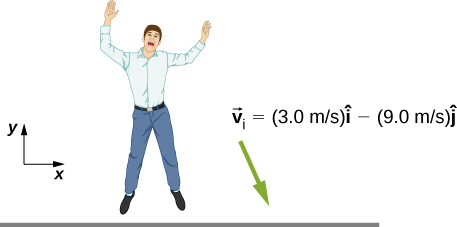
- First discover the impulse on the person from the impact on the ground. Calculate both its magnitude and management.
- Discover the average strength on the anxiety if the person keeps his leg stiff and straight and his center of mass drops by simply 1 cm vertically and 1 cm horizontally during the touch.
- Find the boilerplate force on the feet if the person bends his legs throughout the impact and then that his heart of mass drops past 50 cm vertically and 5 cm horizontally during the affect.
- Compare the results of office (b) and (c), and draw conclusions about which way is improve.
You volition need to detect the time the affect lasts by making reasonable assumptions most the deceleration. Although the force is not constant during the bear upon, working with constant average force for this problem is adequate.
a. [latex] 617\,\text{Due north}·\text{s} [/latex], 108°; b. [latex] {F}_{x}=2.91\,×\,{ten}^{four}\,\text{N} [/latex], [latex] {F}_{y}=2.6\,×\,{10}^{five}\,\text{N} [/latex]; c. [latex] {F}_{x}=5265\,\text{N} [/latex], [latex] {F}_{y}=5850\,\text{N} [/latex]
Two projectiles of mass [latex] {1000}_{1} [/latex] and [latex] {m}_{2} [/latex] are fired at the same speed only in contrary directions from 2 launch sites separated by a distance D. They both reach the aforementioned spot in their highest indicate and strike there. As a consequence of the impact they stick together and move as a single trunk afterwards. Observe the place they will state.
Two identical objects (such as billiard balls) accept a ane-dimensional collision in which ane is initially motionless. After the collision, the moving object is stationary and the other moves with the same speed as the other originally had. Show that both momentum and kinetic free energy are conserved.
Evidence Solution
Conservation of momentum demands [latex] {m}_{i}{v}_{\text{1,i}}+{k}_{2}{v}_{\text{two,i}}={m}_{1}{v}_{\text{1,f}}+{m}_{ii}{v}_{\text{2,f}} [/latex]. We are given that [latex] {m}_{one}={1000}_{2} [/latex], [latex] {5}_{\text{1,i}}={v}_{\text{2,f}} [/latex], and [latex] {v}_{\text{2,i}}={five}_{\text{1,f}}=0 [/latex]. Combining these equations with the equation given by conservation of momentum gives [latex] {v}_{\text{one,i}}={v}_{\text{1,i}} [/latex], which is true, so conservation of momentum is satisfied. Conservation of energy demands [latex] \frac{1}{2}{m}_{i}{v}_{\text{ane,i}}^{ii}+\frac{1}{2}{thou}_{two}{5}_{\text{two,i}}^{2}=\frac{1}{2}{chiliad}_{i}{v}_{\text{i,f}}^{2}+\frac{i}{2}{thou}_{2}{v}_{\text{2,f}}^{ii} [/latex]. Once more combining this equation with the conditions given above requite [latex] {v}_{\text{1,i}}={v}_{\text{1,i}} [/latex], then conservation of energy is satisfied.
A ramp of mass M is at rest on a horizontal surface. A pocket-sized cart of mass m is placed at the top of the ramp and released.
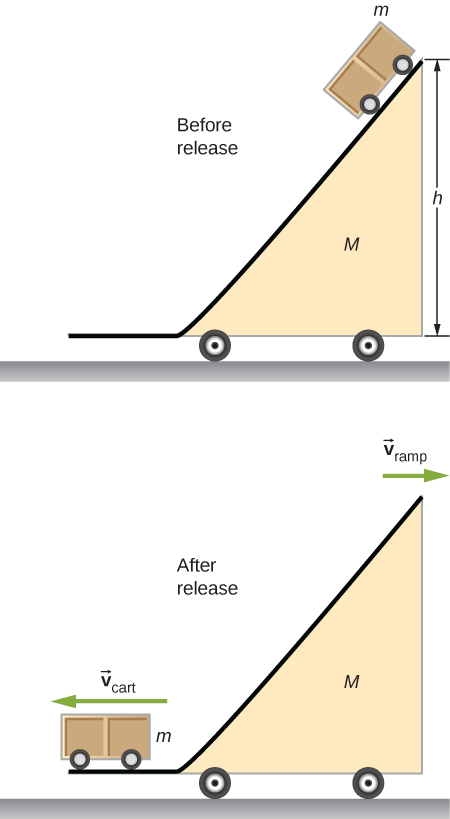
What are the velocities of the ramp and the cart relative to the footing at the instant the cart leaves the ramp?
Observe the eye of mass of the construction given in the figure beneath. Assume a uniform thickness of 20 cm, and a uniform density of [latex] 1{\,\text{g/cm}}^{3}. [/latex]
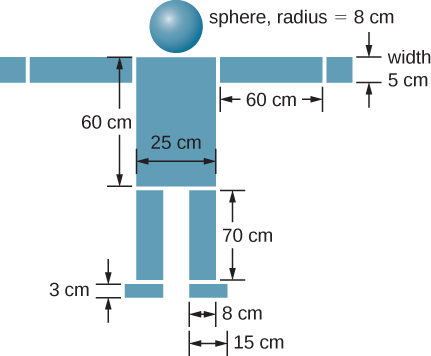
Assume origin on centerline and at floor, and then [latex] ({x}_{\text{CM}},{y}_{\text{CM}})=(0,86\,\text{cm}) [/latex]
Glossary
- rocket equation
- derived past the Soviet physicist Konstantin Tsiolkovsky in 1897, information technology gives u.s. the change of velocity that the rocket obtains from called-for a mass of fuel that decreases the full rocket mass from [latex] {m}_{\text{i}} [/latex] down to m
thompsonphrebre92.blogspot.com
Source: https://courses.lumenlearning.com/suny-osuniversityphysics/chapter/9-7-rocket-propulsion/#:~:text=Yes%2C%20the%20rocket%20speed%20can,depends%20on%20conservation%20of%20momentum.
0 Response to "Can the Speed of a Rocket Exceed the Exhaust Speed of the Fuel"
Postar um comentário